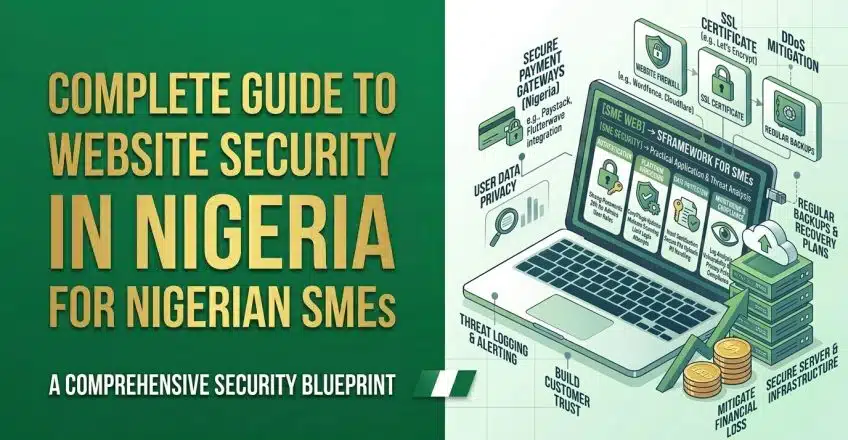

Operating a digital enterprise in the local business landscape requires proactive risk management strategies that extend far beyond simply launching an attractive frontend layout. As more small and medium enterprises shift their storefronts online, cyber threats such as automated brute-force attacks, malware injections, and database defacements have increased exponentially. For an organization operating within major commercial centers like Lagos, Ibadan, or Abuja, an unexpected security breach can completely halt daily operations, erase vital customer records, and permanently damage hard-earned brand credibility in an instant.
Implementing Robust Website Security in Nigeria for Businesses
Building a resilient online profile means recognizing that digital assets are constantly targeted by global and local malicious bots. Many business owners mistakenly believe that cybercriminals only target multi-national corporations, leaving smaller digital platforms unprotected and highly vulnerable. When a website is compromised, attackers frequently use the server’s processing power to distribute spam scripts, harvest user data, or inject malicious ads, which quickly alerts search engine crawlers and results in immediate blacklisting.
Furthermore, dealing with sudden infrastructural realities like power grid instability or erratic mobile network coverage makes recovering from a cyberattack even more challenging. If your server database is corrupted or hijacked while your IT team is facing local connectivity bottlenecks, your digital storefront could remain offline for days. Prioritizing backend protection from the ground up guarantees that your automated services, lead generation funnels, and customer databases remain fully functional and isolated from external threats.
For freelance web developers and corporate administrators managing multiple client platforms, failing to secure a single configuration file can expose an entire network of connected sites. Simple vulnerabilities, such as outdated plugins, weak administrative passwords, and unencrypted file transfer protocols, are the primary entry points for automated scanning tools used by hackers. Establishing clear, rigorous defensive parameters ensures your web application maintains structural integrity even during aggressive traffic spikes or targeted scanning campaigns.
Why Website Security in Nigeria Is Critical for Brand Reputation
The commercial consequences of neglecting your digital perimeter can be catastrophic in a market driven by trust and word-of-mouth recommendations. When a prospective client visits your platform only to be greeted by a browser warning concerning a suspicious connection, they will instantly migrate to a competitor. Maintaining a clean security record is a vital component of business formalization, ensuring that your online presence commands respect and reflects professional corporate standards.
When your underlying server environment is hardened against intrusions, it smoothly accommodates introductory artificial intelligence tools, such as automated data analysis scripts or ChatGPT customer engagement modules, without introducing new vectors for code exploitation. Advanced script integrations function best when they are deployed inside an isolated, closely monitored ecosystem where user permissions are tightly restricted. This balanced approach protects your intellectual property while allowing your business to scale using modern automation tools.
Best Practices for Maintaining Website Security in Nigeria
Achieving comprehensive digital protection involves deploying layered defensive protocols that neutralize threats before they can access your core source files. By establishing automated scanning routines and enforcing strict access controls, you can keep your platform running smoothly without requiring a team of full-time cybersecurity experts.
You must implement the following technical safety measures to safeguard your digital infrastructure completely:
-
Install an enterprise-grade Secure Sockets Layer certificate to encrypt all data transmitted between the visitor’s mobile browser and your server.
-
Implement two-factor authentication on all administrative dashboards to block automated brute-force login attempts effectively.
-
Change the default login directory paths of your content management systems to mask your administrative portals from automated scanning bots.
-
Set up automated daily cloud backups that store your website files and databases securely offsite, allowing for immediate restoration during emergencies.
-
Enforce strict file permissions on your hosting directory, ensuring that configuration files remain unmodifiable by unauthorized backend scripts.
-
Update all core system frameworks, themes, and design plugins weekly to patch known code vulnerabilities immediately.
A thoroughly protected digital storefront depends entirely on a hosting environment built with defensive infrastructure from the ground up. Keeping your corporate assets insulated from malicious traffic requires an optimized server setup. Deploy your fast, secure web applications on SternHost today. For just ₦1,195.00/month, you receive the enterprise-grade caching, unmetered bandwidth, and raw server processing speed necessary to scale your operations flawlessly 24/7.