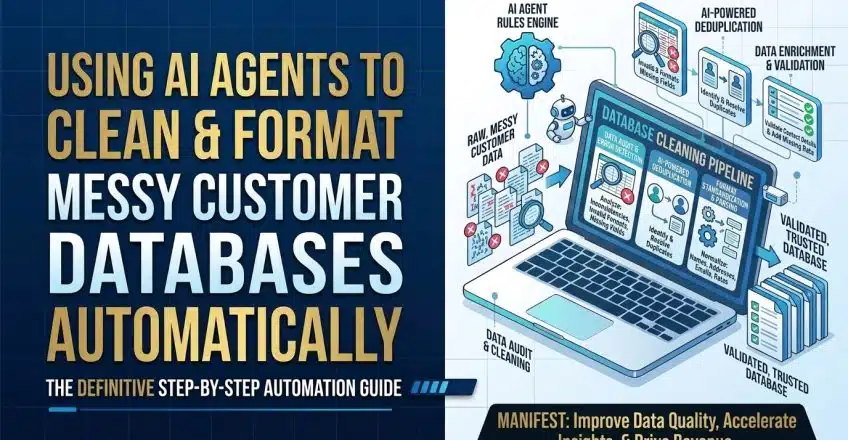

Customer data is the most valuable asset for any growing business in the Nigerian digital economy, yet it is often the most disorganized. When local businesses run marketing campaigns across Lagos, Abuja, or Port Harcourt, they collect thousands of leads through Google Forms, WhatsApp messages, and unstructured email inquiries. Over time, this results in a chaotic mix of missing phone numbers, misspelled names, duplicate entries, and incorrectly formatted email addresses. When your sales team attempts to use this messy data to close deals or send automated payment links for local gateways like Paystack, the campaigns fail, leading to high bounce rates and lost revenue.
Solving this data chaos manually requires hundreds of administrative hours, which most local startups and tech agencies simply cannot afford, especially when dealing with daily operational hurdles like power grid fluctuations. By deploying intelligent automation tools, businesses can now instruct artificial intelligence to automatically scan, organize, and correct these disorganized records. Relying on AI agents to clean customer databases ensures that your client relationship management (CRM) systems contain only verified, standardized, and immediately actionable data without requiring a human to sift through every spreadsheet row.
Scaling Operations with AI Agents to Clean Customer Databases
The primary advantage of utilizing automated data sanitization is the complete elimination of human error and repetitive administrative bloat. In a fast-paced market where responding to a lead within five minutes is critical, having a database filled with invalid phone numbers completely derails your sales momentum. Intelligent systems act as a continuous filter between your lead generation forms and your core CRM. When a new prospect enters their details in a messy format, the intelligent agent intercepts the data, detects the errors, standardizes the capitalization, formats the phone number to the correct Nigerian country code, and then securely pushes the clean data to your sales dashboard.
Furthermore, integrating advanced natural language processing allows these systems to handle complex contextual errors that traditional software cannot. For example, if a user inputs their address as “VI, Lag” instead of “Victoria Island, Lagos,” basic Excel formulas will fail to categorize it correctly. An intelligent model understands the regional context, instantly expanding the abbreviation into a fully standardized location string. This level of precise geographical organization is vital for local e-commerce and logistics businesses planning delivery routes or targeted SMS campaigns.
Why AI Agents to Clean Customer Databases Save Revenue
Maintaining a bloated list of duplicate or unverified contacts actively burns your operational budget. Digital marketing platforms and CRM software generally charge businesses based on the total number of contacts stored in their system. If thirty percent of your list consists of duplicate entries, dummy emails, or numbers lacking the “+234” country code, you are paying for dead weight. Deploying automation immediately purges this waste, optimizing your monthly software subscriptions.
Additionally, launching outbound email or SMS campaigns using unverified data severely damages your domain reputation. If search engines and local telecommunication providers detect that you are constantly sending messages to invalid addresses, they will permanently blacklist your business. Automating your data hygiene ensures every message you send lands exactly where it is supposed to, directly increasing your conversion rates when pushing users toward local payment checkout portals like Flutterwave.
Tools and Steps for Deploying AI Agents to Clean Customer Databases
Setting up a self-cleaning data architecture requires connecting your raw lead sources to a powerful enrichment engine and a highly customizable automation platform. You do not need to build complex Python scripts; modern visual node-based systems can handle the entire transformation pipeline.
You must follow these precise steps and utilize platforms like n8n, Clay, and OpenAI to construct a reliable, automated data-cleaning workflow:
-
Connect your raw data source: Set up an initial webhook in n8n to instantly catch new lead entries the moment a customer submits a form on your website or interacts with your digital ads.
-
Route the raw data to Clay: Use the n8n visual dashboard to push the incoming messy data directly into Clay, a platform specifically designed for data enrichment and algorithmic cleaning.
-
Configure AI correction prompts: Within Clay, apply a custom OpenAI prompt to evaluate the data. Instruct the model to specifically capitalize first names, correct obvious spelling errors, and standardize all local addresses into proper regional formats.
-
Automate phone number formatting: Add a specific transformation step that scans the phone number field, removes any spaces or dashes, and automatically prepends the Nigerian “+234” dial code if the user entered their number starting with a zero.
-
Filter and push to your CRM: Configure a final logic node in n8n that checks if the AI successfully validated the email and phone number. If verified, push the clean record into your HubSpot or Zoho CRM; if invalid, tag it for manual review.
Running continuous algorithmic background checks and API data transfers requires a server environment that will not drop connections during intensive processing. Deploy your fast, secure web applications on SternHost today. For just ₦1,195.00/month, you receive the enterprise-grade caching, unmetered bandwidth, and raw server processing speed necessary to scale your operations flawlessly 24/7.