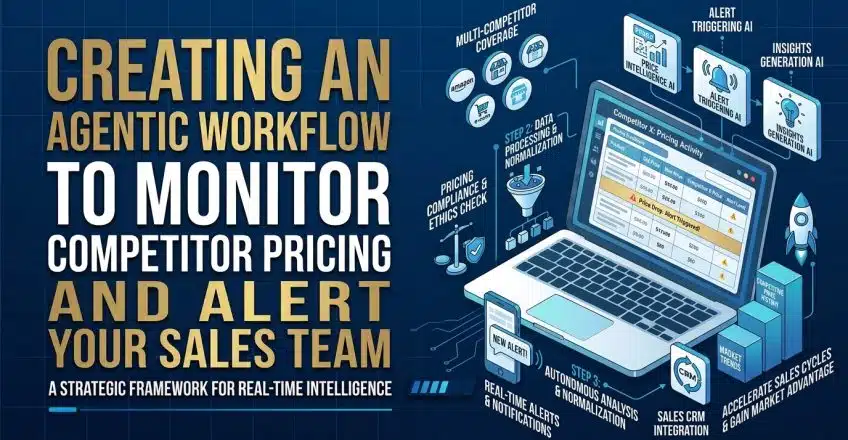

Operating a competitive digital business in Nigeria demands constant vigilance over market trends and rival strategies. Whether you are selling wholesale electronics, software subscriptions, or specialized logistics services, competitors frequently adjust their rates to capture price-sensitive buyers. Relying on your human sales team to manually check rival websites every morning is highly inefficient, especially when dealing with unpredictable power grid fluctuations and mobile internet latency. When your staff is disconnected, a competitor could launch a massive flash sale, aggressively undercutting your market share while your team remains entirely unaware.
Transitioning from manual tracking to an automated intelligence system fundamentally changes how your business reacts to market shifts. By deploying autonomous software that continuously scans the digital landscape without human intervention, you gain real-time strategic visibility. This ensures that your local sales representatives are instantly notified the second a competitor drops their prices, allowing you to counter-offer immediately and prevent high-value corporate clients from churning.
Scaling Operations with Agentic Price Monitoring
Traditional web scrapers are notoriously brittle; if a competitor simply changes the layout of their digital storefront, a basic script breaks immediately. An agentic price monitoring framework solves this by utilizing artificial intelligence to actively read and reason through the competitor’s website, much like a human analyst would. These intelligent systems understand context, meaning they can distinguish between a temporary weekend discount and a permanent structural price drop. By filtering out the noise, your agents only alert your sales team when a genuine competitive threat emerges.
Furthermore, integrating this autonomous workflow directly into your daily operations allows your team to focus exclusively on closing deals rather than conducting tedious research. When a prospect mentions a competitor’s pricing on a sales call, your team does not need to pause and verify the claim. The AI agent has already updated your internal database and pushed an alert directly to your team’s mobile devices, empowering them to justify your pricing or offer a strategic discount through local gateways like Paystack or Flutterwave.
Why Agentic Price Monitoring Protects Local Margins
The financial consequences of reacting too late to a competitor’s pricing shift are severe in a market driven by tight operational budgets. If a rival agency suddenly reduces their retainer fees, they can easily poach your top clients before you even realize what happened. Deploying an autonomous tracking system acts as a digital insurance policy. The moment an anomaly is detected in the market, the agentic price monitoring setup evaluates your current profit margins and instantly advises your team on the safest counter-strategy, ensuring you do not blindly slash prices and destroy your profitability.
Additionally, this workflow minimizes the bandwidth and data costs associated with extensive manual market research. Instead of your staff spending hours loading heavy, graphic-intensive competitor websites over expensive 3G or 4G mobile networks, the cloud-based AI agent handles all the heavy data lifting in the background. It only transmits highly compressed text alerts to your local team, respecting their data limitations while keeping them perfectly informed.
Tools and Steps for Agentic Price Monitoring
To build a reliable, self-healing tracking system, you must connect specialized data extraction tools with powerful logic builders and large language models. You do not need to write complex Python code; modern visual workflow platforms allow you to orchestrate these agents seamlessly.
You must implement the following precise steps and utilize platforms like Apify, n8n, and OpenAI to construct your monitoring pipeline:
-
Set up a scheduled trigger in a workflow automation platform like n8n or Make.com to initiate the monitoring process every morning.
-
Connect an extraction tool like Apify or Bright Data to scrape the specific product URLs or pricing pages of your top regional competitors.
-
Route the extracted raw text directly into an AI node powered by OpenAI or Anthropic’s Claude, instructing the model to act as a pricing strategist.
-
Prompt the AI to compare the newly scraped prices against your current database, asking it to explicitly identify if the competitor’s price is a temporary flash sale or a permanent reduction.
-
Add a conditional logic router that only proceeds if the competitor’s price drops below a specific threshold that threatens your business.
-
Configure a final messaging module to instantly push a structured alert via Slack or a Twilio WhatsApp integration, delivering the exact price difference and a suggested counter-offer directly to your sales manager’s phone.