
Closing high-value corporate contracts in the Nigerian tech space often comes down to the speed and professionalism of your initial proposal. When local business owners in commercial centers like Lagos, Abuja, or Port Harcourt request a quotation for an e-commerce platform or custom web application, they rarely wait weeks for an agency to respond. If your team takes five days to draft a comprehensive scope of work while dealing with daily power grid instability and erratic internet access, more agile competitors will submit their pitches first and secure the contract.
Traditional proposal drafting is notoriously inefficient for freelance developers and boutique agencies. Developers often get bogged down in technical jargon, explaining database architectures and JavaScript frameworks to non-technical business executives who only care about revenue, speed, and reliability. Leveraging generative artificial intelligence bridges this communication gap immediately. By using structured prompts, you can translate complex technical requirements into value-driven, persuasive business documents within minutes.
Drafting ChatGPT Web Development Proposals That Win Deals
The fundamental reason most developer pitches fail locally is a failure to align with commercial realities. Nigerian decision-makers are heavily focused on return on investment, data efficiency for their mobile audience, and seamless integration with trusted payment processors like Paystack and Flutterwave. When you use artificial intelligence to structure your pitch, you can train the model to emphasize these exact business outcomes rather than dry technical specifications.
Furthermore, integrating intelligent drafting workflows protects your agency from the dreaded trap of scope creep. Inexperienced developers often write vague proposals that leave room for clients to demand endless revisions without additional pay. Instructing a language model to outline precise deliverables, explicit milestone timelines, and strict revision limits establishes clear boundaries before any code is written, ensuring your team remains profitable throughout the project lifecycle.
Why ChatGPT Web Development Proposals Convert Local Clients
A winning technical proposal must address the specific infrastructural concerns of the Nigerian market. Corporate clients know that their customers browse on fluctuating 3G and 4G networks using budget smartphones. When your pitch explicitly outlines how your web design will minimize payload sizes, optimize caching, and guarantee uptime despite local hosting challenges, it immediately builds trust.
Using artificial intelligence allows you to generate customized, bespoke sections for every prospective lead without starting from scratch. Instead of sending a generic PDF template that looks mass-produced, you can input a client’s website URL, industry sector, and stated pain points to generate a tailored value proposition. This demonstrates deep attention to detail, positioning your brand as an elite strategic partner rather than a cheap, commoditized coder.
Tools and Steps for ChatGPT Web Development Proposals
To create proposals that consistently win deals, you should combine conversational AI models with cloud document platforms. Feeding precise context into the software yields structured, client-ready proposals that can be sent before your competitors have even opened a blank document.
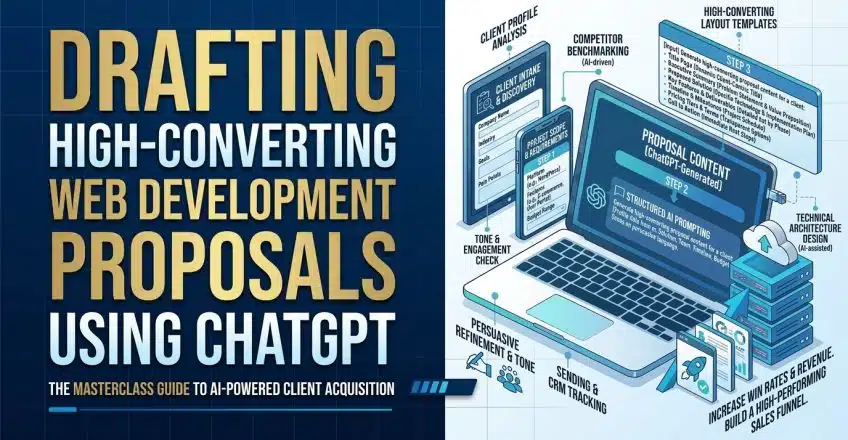
You must follow these precise steps and utilize tools like ChatGPT alongside Google Docs or PandaDoc to build high-converting pitches:
-
Gather the prospect’s project brief, target audience demographics, core business goals, and budget range during your initial discovery call.
-
Open ChatGPT and instruct the model to act as a senior technical sales consultant specializing in the Nigerian digital commerce market.
-
Feed the raw client requirements into the prompt, asking the AI to structure the output into standard sections: Executive Summary, Proposed Technical Solution, Scope of Deliverables, Project Timeline, and Investment Breakdown.
-
Demand that the AI outline explicit milestone stages, structuring payments into a 50% upfront commitment, 30% milestone review, and 20% final deployment balance.
-
Instruct the model to draft an explicit “Out of Scope” section to eliminate potential scope creep regarding extra revisions or unplanned third-party API integrations.
-
Transfer the generated text into Google Docs or PandaDoc, add your corporate branding and portfolio case studies, and export the document as a clean, lightweight PDF.