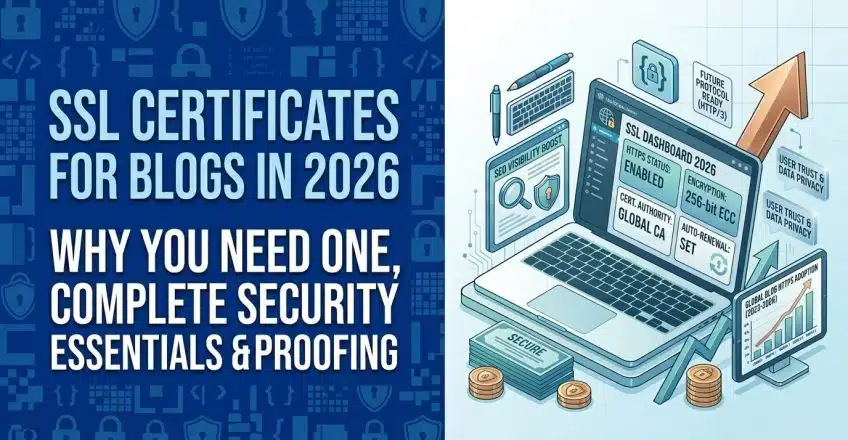

When a new reader clicks on your latest article, the very first thing their browser does is check the security of your website. If they are greeted with a glaring “Not Secure” warning next to your URL, the quality of your writing no longer matters; they will close the tab immediately. In the modern web ecosystem, securing the connection between your server and your visitors is no longer an optional technical upgrade—it is the baseline requirement for running a successful digital publication.
At its core, Secure Sockets Layer (SSL) technology encrypts the data transferred between a user’s web browser and your web server. When you install this digital certificate, your website URL transforms from the vulnerable HTTP protocol to the secure HTTPS standard, and a reassuring padlock icon appears in the browser’s address bar.
The Ultimate Guide to SSL Certificates for Blogs
Many new creators mistakenly believe that because they are just running a simple WordPress site and not processing direct credit card transactions, they do not need encryption. This is a massive misconception that will actively harm your audience growth and digital reputation.
Securing your platform is about much more than just preventing hackers from intercepting financial data. It is about proving to both search algorithms and human readers that your infrastructure is professional, actively maintained, and safe to interact with.
Why SSL Certificates for Blogs Are Mandatory in 2026
Operating without encryption is one of the fastest ways to destroy your organic traffic. The internet has shifted to a “secure-by-default” model, and platforms that refuse to adapt are systematically hidden from public view.
-
Search Engine Optimization: Google and other major search engines actively penalize unencrypted websites. If you want your articles to rank on the first page of search results, an active SSL is a mandatory, non-negotiable ranking factor.
-
Data Protection: Even if you do not sell products, you likely collect email addresses for your newsletter, require user logins, or allow readers to leave comments. Encryption ensures that this personal data cannot be intercepted by malicious third parties over public Wi-Fi networks.
-
Browser Warnings: Modern browsers like Chrome, Firefox, and Safari are incredibly aggressive toward unencrypted sites. They frequently block users from visiting HTTP URLs entirely, displaying full-page security warnings that scare away potential subscribers.
Choosing the Right SSL Certificates for Blogs
The good news is that securing your digital content does not have to be an expensive or technically exhausting process. For the vast majority of independent publishers, portfolio sites, and educational portals, a standard Domain Validation (DV) certificate is completely sufficient.
You do not need to spend hundreds of dollars on Extended Validation (EV) certificates unless you are running a massive corporate enterprise or a major banking portal. Automated, free certificates provided by authorities like Let’s Encrypt offer the exact same level of 256-bit encryption and are trusted by all major global browsers.