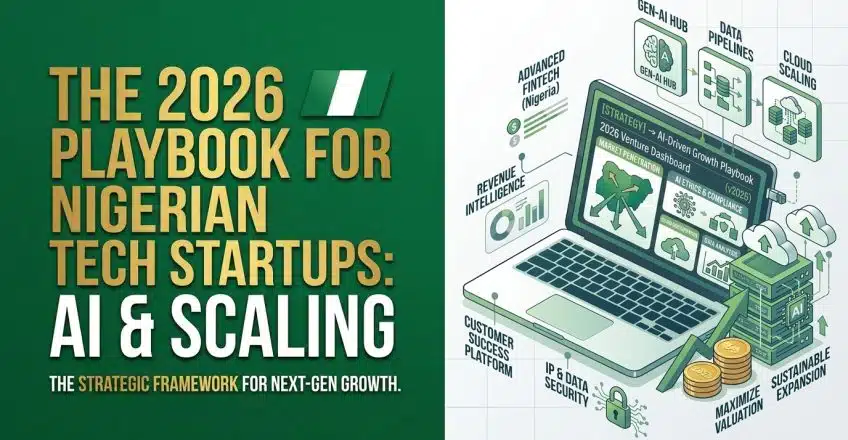

The era of “growth at all costs” across the African tech ecosystem has officially ended. For founders operating in Lagos, Abuja, or emerging hubs like Jos, 2026 is defined by a ruthless focus on capital efficiency, strict regulatory compliance, and actual profitability. Investors are no longer writing massive checks based purely on a bold vision; they are demanding clear unit economics and sustainable business models. To survive and scale a digital product in this mature market, you must transition from burning cash on customer acquisition to building incredibly efficient, automated operational systems.
The 2026 Playbook for Nigerian Tech Startups
The technological landscape in the country is shifting rapidly to support this new drive for efficiency. The integration of advanced tools is no longer a luxury reserved for heavily funded companies; it is a fundamental survival requirement. If you are building an AI-powered learning platform to cater to thousands of local students or developing an agritech supply chain dashboard, relying on manual data entry and disjointed communication channels will drain your runway instantly.
-
AI-Powered Automation: Artificial intelligence is moving out of the “pilot phase.” Successful local businesses are deploying autonomous agents to handle tier-one customer support, grade digital assessments, and manage complex database queries without human intervention.
-
Regulatory Compliance as a Feature: With the National Information Technology Development Agency (NITDA) enforcing stricter digital economy frameworks and data protection laws, building compliant, highly secure applications is now a massive competitive advantage.
-
Niche Market Focus: Instead of trying to build the next generic super-app, the most successful founders are solving deeply specific local problems. Architecting a platform tailored specifically to standardized exam preparations or specialized medical consulting yields far higher retention rates.
Scaling Infrastructure for Nigerian Tech Startups
Building an innovative product utilizing rapid prototyping workflows is only the first step. When your platform actually hits the market and begins acquiring active users, the underlying infrastructure must be able to withstand the pressure. In 2026, the local ecosystem is seeing a massive shift toward robust, high-performance web architecture to combat issues like internet latency and server downtime.
If your application relies on real-time API streams to process local payments or to deliver streaming video content for remote learners, a slow backend will immediately destroy the user experience. You must architect your systems to handle concurrent connections smoothly, utilizing aggressive edge caching and reliable database routing to ensure absolute stability.
The Foundation for Sustainable Digital Growth for Nigerian Tech Startups
Scaling a digital business in this economic climate means optimizing every single fixed cost. You cannot afford to pay for bloated, inefficient server environments that crash the moment a marketing campaign goes viral or a complex website migration is executed. Your hosting infrastructure must be as agile, secure, and efficient as the codebase you have deployed on it.
Whether you are launching an educational management system, deploying a secure portal for a consulting agency, or scaling a dynamic eCommerce store, you need uncompromising server power. Deploy your digital platforms on SternHost today. For just ₦1,195.00/month, you receive the unmetered bandwidth, enterprise-grade security, and raw processing speed necessary to keep your automated operations running flawlessly across Nigeria and beyond.