
Imagine walking into a bank in Lagos to open an account. You walk up to the counter, but instead of a security guard and bulletproof glass, the door is wide open, and money is sitting on the counter. Would you deposit your hard-earned Naira there? Absolutely not. You would turn around and walk out immediately.
In the digital world, your website is that bank.
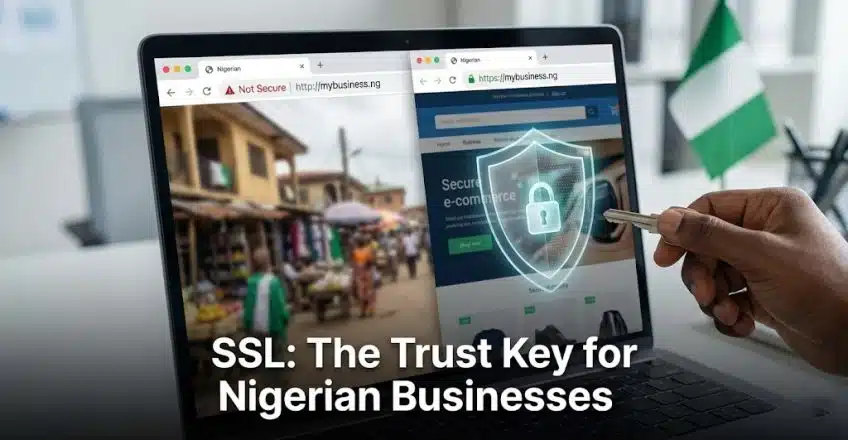
If you visit your business website on Chrome or Safari right now, look at the address bar. Do you see a padlock icon, or do you see a warning that says “Not Secure”?
If you see “Not Secure,” you are losing customers every single day. In a Nigerian market where internet users are already hyper-cautious about scams and data theft, security is not just a feature—it is the foundation of your business. The tool you need to fix this is called an SSL certificate.
What Exactly Is an SSL Certificate?
SSL stands for Secure Sockets Layer. It sounds complicated, but the concept is simple.
Think of the internet like sending a letter through the post office.
-
Without an SSL certificate: You are sending your customer’s data (passwords, card details, emails) on a postcard. Anyone handling the mail—hackers, identity thieves—can read it.
-
With an SSL certificate: You are putting that data inside a sealed, armored envelope. Only you and the customer have the key to open it.
When you install an SSL certificate on your domain, your URL changes from http:// to https://. That little “s” stands for Secure.
Why an SSL Certificate Is Non-Negotiable in Nigeria
The Nigerian digital landscape is unique. We have one of the highest rates of mobile internet usage in the world, but we also battle a reputation for cybercrime. Here is why an SSL certificate is critical for your survival.
1. Killing the “Fear Factor”
Nigerians are smart shoppers. We have been trained to look for red flags. If a customer tries to buy a wig or pay for a service on your site and their browser warns them that the connection is “Not Secure,” they will assume your site is fake or compromised. An SSL certificate puts the padlock icon next to your name, instantly signaling that you are a legitimate, safe business.
2. Protecting Customer Data
Under the Nigeria Data Protection Act (NDPA), businesses are legally required to protect user data. If you are collecting names, phone numbers, or processing payments via Paystack/Flutterwave, you have a responsibility to encrypt that data. An SSL certificate ensures that the communication between your customer’s phone and your server is encrypted and unreadable to hackers.
The SEO Advantage: How an SSL Certificate Helps You Rank
Google made a massive change a few years ago. They explicitly stated that they prefer secure websites.
If you and your competitor have similar content, but they have an SSL certificate and you don’t, Google is likely to rank them higher.
-
Google wants to provide a safe experience for its users.
-
Sites with SSL certificates are viewed as higher quality.
By ignoring SSL, you aren’t just scaring humans; you are telling Google that your site is outdated.
Do You Need to Pay for an SSL Certificate?
In the past, SSL certificates were expensive luxuries reserved for big banks. Today, that has changed.
At SternHost.ng, we believe security should be standard, not an upgrade. That is why we provide free Auto-SSL with our hosting plans. We automatically issue and renew a valid SSL certificate for your domain so you never have to worry about the “Not Secure” warning again.
However, for larger eCommerce stores or financial institutions requiring higher validation levels, premium SSL certificate options are available to display even more trust indicators (like a dynamic site seal).
Conclusion: Lock the Door
You wouldn’t leave your shop unlocked at night in Balogun Market. Don’t leave your website unlocked on the internet.
Installing an SSL certificate is the quickest, most effective way to tell your Nigerian customers: “Your data is safe with me.”
[Check if your site is secure. Get a hosting plan with a free SSL Certificate from SternHost.ng today.]