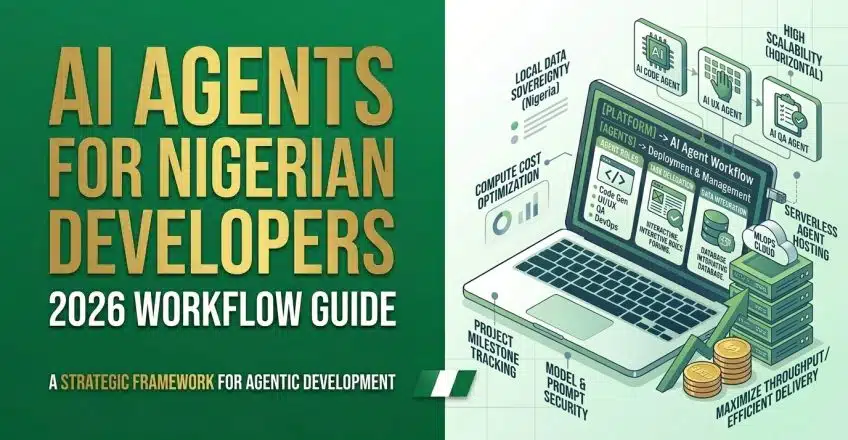

The technology ecosystem across the country is moving at an unprecedented pace. Building massive platforms, especially in high-demand sectors like educational technology or fintech, requires more than just manual typing and long nights debugging syntax errors. When you are trying to scale an application to thousands of active users, relying solely on traditional programming methods creates a massive bottleneck. To ship features faster and maintain a competitive edge, you must transition your workflow from writing every single line of code to directing autonomous digital workers to architect your systems for you.
The 2026 Guide to AI Agents for Nigerian Developers
The era of using simple chatbots to answer basic coding questions is over. The standard approach for rapid prototyping has officially shifted toward utilizing agent-first environments like the Antigravity IDE. This allows you to engage in “vibe coding,” where you describe the core logic of a complex feature—such as an automated scholarship recommendation engine or a CBT simulation module—and the agent autonomously writes, tests, and refactors the underlying architecture.
However, leveraging these tools effectively within the local market requires a deep understanding of how to integrate them into modern, scalable tech stacks. You are no longer just a programmer; you are a systems builder managing an AI-driven engineering team.
Automating Workflows with AI Agents for Nigerian Developers
Building a resilient full-stack application requires connecting multiple complex layers. When you are bridging dynamic React frontends with powerful Node.js runtimes, the boilerplate configuration can consume weeks of development time. Autonomous tools excel at eliminating this repetitive friction, allowing you to focus purely on the business logic.
-
Seamless Database Migrations: Whether you are managing unstructured data in MongoDB or architecting strict relational schemas in Supabase, agents can automatically generate the precise TypeScript migration files required to update your database safely without dropping live user data.
-
API Route Generation: Instead of manually writing repetitive CRUD endpoints, you can instruct your environment to scaffold highly secure backend routes that handle everything from user authentication to processing localized payment gateway webhooks.
-
Automated Test Coverage: Pushing untested code to a live student portal or retail dashboard is a recipe for disaster. You can deploy background agents to continuously write unit tests for your React components, ensuring that your user interface remains completely bug-free across all mobile devices.
Security Best Practices with AI Agents for Nigerian Developers
While the speed of agentic development is phenomenal, granting an autonomous system access to your source code introduces massive security vulnerabilities. If you are not careful, a hallucinating model can accidentally expose your production database credentials or push malicious dependencies to your server.
You must enforce strict sandboxing within your development environment. Ensure that your agents operate with the principle of least privilege, meaning they never have access to your live .env files. Furthermore, always implement an evaluation-first architecture where the generated code is thoroughly vetted by automated CI/CD pipelines before it is ever merged into your main production branch.
Running complex, agent-driven workflows and deploying the resulting full-stack web applications demands raw computational power. A sluggish backend will cause your Node.js API routes to time out and your React applications to crash under heavy user load. Deploy your highly optimized, AI-generated platforms on SternHost today. For just ₦1,195.00/month, you receive the unmetered bandwidth, enterprise-grade server processing speed, and unshakeable reliability necessary to power your ambitious tech startup flawlessly 24/7.