
Launching a digital storefront in the Nigerian ecosystem requires more than just an attractive website design and a functional payment gateway. The moment your platform begins collecting user data—whether through simple contact forms, account registrations, or checkout pages routed through Paystack—you are legally bound to protect that information. Historically, drafting comprehensive legal documents required hiring specialized technology lawyers, an expense that severely strained the operational budgets of early-stage startups and freelance developers. Consequently, many founders resorted to copying and pasting random policies from foreign websites, leaving their businesses dangerously exposed to local regulatory fines.
The introduction of the Nigeria Data Protection Act (NDPA) in 2023 has made strict compliance mandatory for any entity processing the personal data of Nigerian citizens. The Nigeria Data Protection Commission (NDPC) actively enforces these regulations, and non-compliance carries severe financial penalties. To bridge the gap between expensive legal counsel and mandatory compliance, modern tech teams are leveraging artificial intelligence. These automated systems can instantly draft precise, localized legal frameworks tailored specifically to your exact business operations and regional legal requirements.
Automating Compliance with AI Policy Generators
Transitioning from manual legal drafting to automated generation ensures your business formalization process moves rapidly. Instead of waiting weeks for a lawyer to return a draft, you can input your specific data collection practices into an intelligent prompt and receive a structured document within minutes. This rapid deployment allows you to launch your marketing campaigns and onboard users safely without technical delays.
When your platform integrates third-party tools—such as Google Analytics for traffic tracking, or Flutterwave for payment processing—your privacy policy must explicitly state how these entities handle user data. Advanced language models excel at mapping these technical integrations into clear, legally sound paragraphs. They ensure that your users understand exactly what data is being collected, why it is necessary, and how they can exercise their rights to delete it.
Why AI Policy Generators Protect Nigerian Businesses
Operating an online business means managing constant operational risks, from power grid instability affecting your local team to sudden drops in mobile internet latency. The last thing a founder needs is a regulatory audit. Relying on generic templates often omits crucial local context, such as the specific age of consent in Nigeria or the explicit procedures for cross-border data transfers if your servers are hosted internationally. AI platforms trained on local regulatory frameworks close these gaps, generating documents that reflect the precise expectations of the NDPC.
Furthermore, digital businesses pivot frequently. You might start by only offering bank transfers and later integrate automated USSD billing. Every time your operational model changes, your Terms of Service and Privacy Policy must be updated to reflect the new data flow. Automated drafting tools allow you to quickly regenerate specific clauses on the fly, ensuring your legal documentation remains perfectly synchronized with your actual frontend website design and backend API integrations.
Steps to Draft Documents using AI Policy Generators
To effectively automate your legal drafting, you must provide the artificial intelligence with highly specific context. A vague prompt will generate a vague policy. You must map out exactly what your website does before requesting the document.
You must follow these precise steps and utilize platforms like ChatGPT, Claude, or dedicated compliance tools to generate your drafts:
-
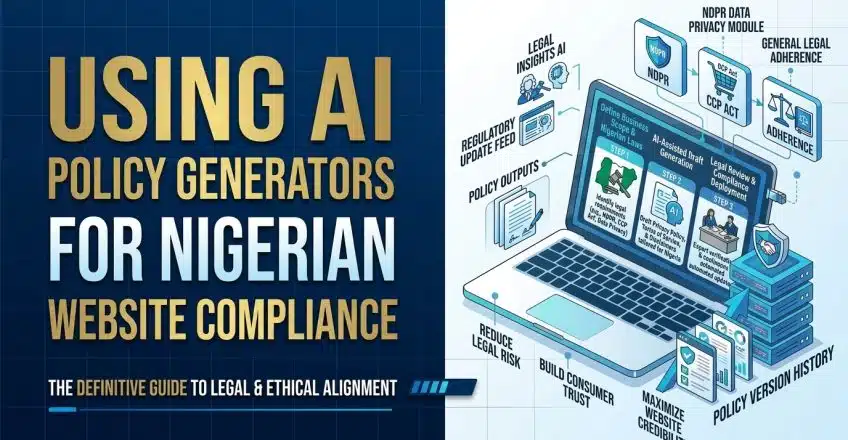
Conduct a data audit: Write down every single piece of information your website collects, including names, IP addresses, browser cookies, and the specific third-party tools (like Paystack or Meta Pixels) that process this data on your behalf.
-
Define your prompt: Open your chosen language model and instruct it to act as a senior data privacy lawyer specializing in the Nigeria Data Protection Act 2023.
-
Feed the data mapping: Paste your data audit into the prompt. Instruct the AI to explicitly detail the lawful basis for processing (e.g., consent or legitimate interest) and outline the data subject rights as mandated by the NDPC.
-
Generate the Terms of Service: In a separate prompt, instruct the AI to draft your Terms of Service. Provide details on your refund policy, user account termination rules, and limitation of liability concerning local network downtime.
-
Review and refine: Read the generated drafts carefully to ensure they match your actual business practices. Never claim to use high-level encryption if you do not actually have it installed.
-
Publish clearly: Place the finalized documents on dedicated pages and link them prominently in your website footer and directly next to any form where users submit their details.