
Operating a modern digital business in Nigeria demands rapid iteration and seamless financial transactions. When local founders develop innovative services or digital products, bridging the gap between automated customer interactions and actual revenue collection has historically been a massive hurdle. Hiring expensive software engineers to manually write custom code connecting artificial intelligence assistants to local banking infrastructure often depletes a startup’s operational capital before the product even reaches the market. Furthermore, deploying untested custom code exposes the business to transaction failures when users experience fluctuating mobile networks across major commercial centers like Lagos and Kano.
Transitioning to visual automation platforms removes these technical barriers entirely. By leveraging visual logic builders, entrepreneurs can seamlessly connect conversational language models directly to their digital bank accounts. This agile approach ensures that when an automated chatbot successfully convinces a customer to make a purchase, it instantly generates and delivers a secure payment link via USSD or card checkout. The entire transaction is finalized without requiring human intervention or a single line of backend programming.
Automating Revenue with No Code AI Payment Integrations
The true power of the modern digital economy lies in creating frictionless operational workflows. In the Nigerian market, where consumers are highly cautious about online fraud and frequently deal with internet latency, any delay between agreeing to purchase and receiving a payment prompt leads to abandoned carts. Implementing robust no code AI payment integrations solves this by allowing you to orchestrate instant data transfers between a customer’s WhatsApp message, an intelligent reasoning engine, and a secure local transaction portal.
When a customer queries an AI-powered assistant about a specific service, the assistant retrieves the pricing data and simultaneously triggers a background webhook. This webhook communicates directly with local payment processors like Paystack or Flutterwave to dynamically generate a unique payment link. The AI then presents this link in a highly compressed, data-friendly text message, respecting the buyer’s bandwidth limitations. If the local power grid fails or your human sales team is offline, your automated system continues to process orders and collect funds uninterrupted.
Why No Code AI Payment Integrations Accelerate Growth
Building your digital infrastructure using visual automation significantly lowers your technical debt. When local gateways update their API security standards or introduce new USSD routing protocols, custom-coded applications often break, requiring weeks of expensive developer maintenance. Visual automation platforms maintain these connections for you, automatically updating their backend modules to ensure your revenue stream is never disrupted by third-party technical changes.
Additionally, this level of automation facilitates deep business formalization. Once a payment is confirmed via the gateway, the automation platform can simultaneously instruct the AI to draft a personalized thank-you email, generate a PDF receipt, and update your cloud-based accounting spreadsheet. This cohesive synchronization builds immediate trust with corporate clients and retail buyers alike, elevating your brand’s reputation in a highly competitive regional market.
Tools and Steps for No Code AI Payment Integrations
To build a reliable automated revenue engine, you must utilize visual builders that natively support complex webhook routing and feature dedicated modules for Nigerian financial infrastructure. Connecting these platforms correctly ensures your transaction data remains encrypted and compliant with local banking regulations.
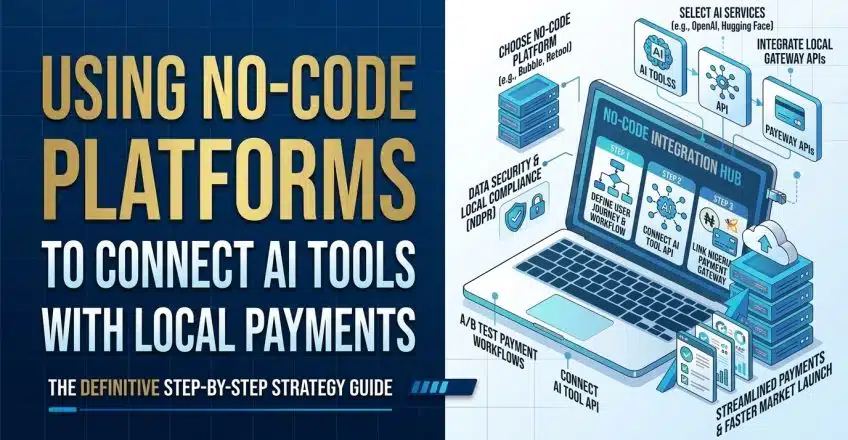
You must utilize platforms like Make.com or Zapier alongside your chosen language models, and follow these exact steps to complete your setup:
-
Create an active merchant account on a local gateway like Paystack or Flutterwave and generate your secret API keys from the developer dashboard.
-
Set up a new scenario in Make.com and add a custom webhook module to listen for incoming customer requests from your website chatbot or WhatsApp business number.
-
Add an OpenAI module directly after the webhook, instructing the language model to analyze the customer’s request and determine the exact product pricing they are inquiring about.
-
Insert an HTTP request module configured to send a POST request securely to your payment gateway’s API, passing the calculated price and generating a dynamic checkout URL.
-
Configure a final messaging module to instantly reply to the customer’s original message, delivering the localized AI response alongside the secure, clickable payment link.