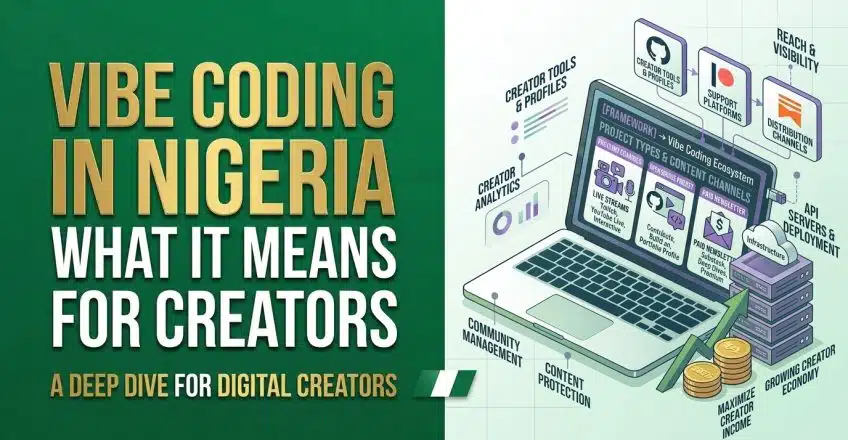

The way we build digital products has fundamentally shifted, and the barrier to entry has completely collapsed. If you have been sitting on an incredible idea for a local startup because you lack the budget to hire a senior engineering team, the rules of the game have changed. The rise of vibe coding in Nigeria means you no longer need to understand syntax or database architecture to bring an idea to life. You simply describe what you want in plain language, and the artificial intelligence generates a working version.
The Rise of Vibe Coding in Nigeria
The term itself was coined in early 2025 by AI researcher Andrej Karpathy to describe a new era of programming where humans let the AI generate the source code while they merely guide and test it. This is not just a fleeting internet trend, as Collins Dictionary actually named it their Word of the Year for 2025. The adoption rates are staggering, particularly for those outside the traditional tech bubble. According to recent data from Hostinger, 63% of people using these tools are not professional developers.
-
These non-developers are successfully building full-stack apps, internal tools, and personal software without ever writing code in the traditional sense.
-
Business and portfolio websites account for 49% of projects built on platforms like Hostinger Horizons.
-
Even within prestigious startup accelerators like Y Combinator, 25% of the companies in the Winter 2025 batch had codebases that were 95% AI-generated.
Balancing Speed with Security for Vibe Coding in Nigeria
For the local ecosystem, this is a massive opportunity to accelerate digital transformation. Tools allow founders to rapidly build prototypes in hours instead of waiting weeks. However, treating AI as a senior developer who never makes mistakes is a dangerous game. While the speed of creation is unprecedented, the quality of the output is highly concerning for anyone building a serious digital business.
-
Analysis shows that AI-generated code produces approximately 1.7 times more issues than human-written code.
-
Furthermore, security audits reveal that 45% of AI-generated code samples fail basic security benchmarks across OWASP Top-10 categories.
-
The most common failure mode is not malicious code, but the AI building a working app while leaving database security policies or authentication logic completely unconfigured.
How to Safely Deploy Vibe Coding in Nigeria
The consequences of ignoring these risks are severe. In February 2026, a social networking platform called Moltbook—built entirely by a founder who had not written a single line of code—suffered a massive data breach. Because nobody manually reviewed the architecture, a misconfigured database exposed 1.5 million API keys and 35,000 email addresses. To succeed with these tools, you must treat the AI output as a starting point, not finished work. You should never push AI-generated code directly to a live server without running basic security checks. It is phenomenal for rapid prototyping and internal tools, but high-stakes production systems processing local payments or sensitive user data require strict human oversight.
Furthermore, as your application scales and attracts real users, the underlying code often becomes messy and bloated. If your hosting environment is weak, this unoptimized code will crash your server instantly. You need a robust backend to handle the inefficiencies of AI-generated applications. Deploy your rapidly built platforms on SternHost today. For just ₦1,195.00/month, you receive the enterprise-grade speed, unmetered bandwidth, and raw server reliability necessary to keep your innovative, AI-generated projects secure and online 24/7.